Gematria Name Numerology – How Hebrew Letters Turn Your Name into Numbers
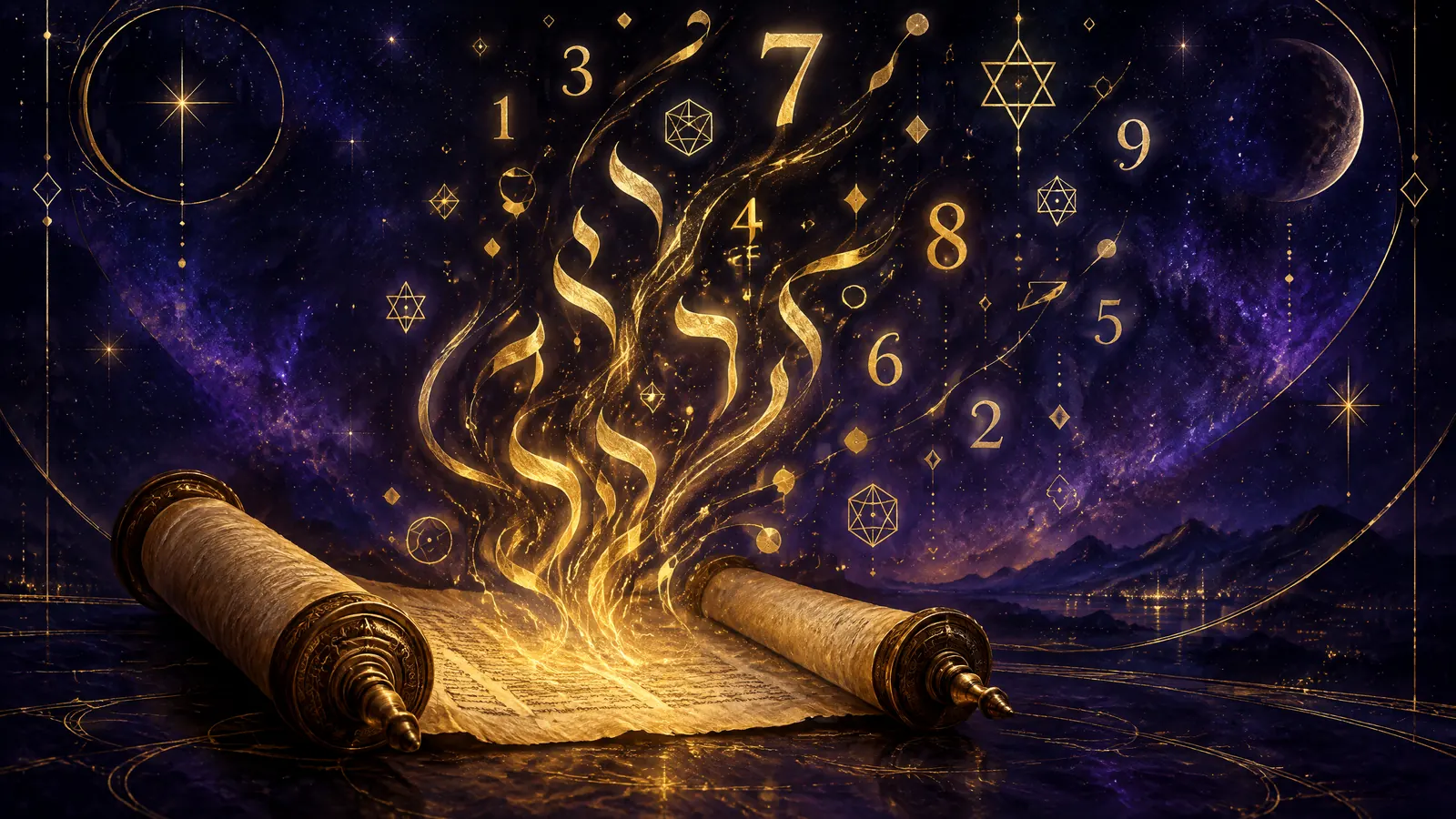
Gematria is the Jewish tradition of reading Hebrew words through number values: each of the 22 Hebrew letters has a value, from aleph (1) to tav (400), and a name's number is the sum of its letters. The name David (דוד), for example, adds up to 14. Words that share a number are read as connected in meaning.
What is gematria?
Gematria is a method of interpretation in which the letters of a Hebrew word are counted as numbers. Hebrew has no separate digits in its traditional script, so letters have long doubled as numerals, and that made counting words a natural step.
Gematria appears in classical rabbinic literature and became especially important in Kabbalah, the Jewish mystical tradition. The Mishnah's tractate Pirkei Avot even mentions gematria as one of the "side dishes" of wisdom, meaning a supporting tool rather than the main course. The Wikipedia article on gematria gives a good overview of its history and methods.
It is worth separating two things. Within Judaism, gematria is a tool of Torah study, used by scholars to draw out connections in sacred texts. Modern name numerology, including what we do in an Estrella soul map, borrows the letter values as a lens for personal reflection. It does not claim religious authority, and it is not a substitute for learning with a teacher of the tradition.
What are the Hebrew letter values in gematria?
The standard system, called mispar hechrechi, gives the first nine letters the values 1 to 9, the next nine the tens from 10 to 90, and the last four the hundreds from 100 to 400. Here is the full table:
| Letter | Name | Value | Letter | Name | Value |
|---|---|---|---|---|---|
| א | Aleph | 1 | ל | Lamed | 30 |
| ב | Bet | 2 | מ | Mem | 40 |
| ג | Gimel | 3 | נ | Nun | 50 |
| ד | Dalet | 4 | ס | Samekh | 60 |
| ה | He | 5 | ע | Ayin | 70 |
| ו | Vav | 6 | פ | Pe | 80 |
| ז | Zayin | 7 | צ | Tsadi | 90 |
| ח | Chet | 8 | ק | Qof | 100 |
| ט | Tet | 9 | ר | Resh | 200 |
| י | Yod | 10 | ש | Shin | 300 |
| כ | Kaf | 20 | ת | Tav | 400 |
What about final letters?
Five Hebrew letters take a different shape at the end of a word: final kaf (ך), mem (ם), nun (ן), pe (ף) and tsadi (ץ). In the standard method they keep the same value as the regular letter, so final mem is still 40.
Some methods, known as mispar gadol, give the final forms the values 500 through 900 instead (final kaf 500, final mem 600, final nun 700, final pe 800, final tsadi 900). There is also a reduced method, mispar katan, which drops the zeros so that every letter becomes a single digit. When you see two different numbers for the same word, the method is usually the reason.
How do you calculate the gematria of a name?
To calculate the gematria of a name, write it in Hebrew letters, look up each letter's value and add them together. Vowels in Hebrew are mostly marked with dots and dashes that carry no number, so only the letters count.
Worked example: David
The name David is written דוד in Hebrew: dalet, vav, dalet.
- ד (dalet) = 4
- ו (vav) = 6
- ד (dalet) = 4
- Total: 4 + 6 + 4 = 14
Fourteen is also the value of the Hebrew word yad (יד), "hand" (yod 10 + dalet 4). Traditional commentators enjoy links like this, and some reduce 14 further to 5 (1 + 4) when looking for a single digit.
Two more examples
- Sarah (שרה): shin 300 + resh 200 + he 5 = 505.
- Chaim (חיים), meaning "life": chet 8 + yod 10 + yod 10 + final mem 40 = 68. The shorter word chai (חי), "alive", is 8 + 10 = 18, which is why 18 is a beloved number in Jewish culture.
How does gematria differ from Pythagorean numerology?
Gematria and Pythagorean numerology both turn letters into numbers, but they come from different alphabets, different cultures and different values. Gematria uses the 22 Hebrew letters with values up to 400. Pythagorean numerology uses the 26 Latin letters, each assigned a single digit from 1 to 9 in repeating rows.
| 1 | 2 | 3 | 4 | 5 | 6 | 7 | 8 | 9 |
|---|---|---|---|---|---|---|---|---|
| A | B | C | D | E | F | G | H | I |
| J | K | L | M | N | O | P | Q | R |
| S | T | U | V | W | X | Y | Z |
Using this table, D-A-V-I-D gives 4 + 1 + 4 + 9 + 4 = 22, a master number in Western numerology. In gematria the same name gives 14. Neither is "right"; they are separate traditions asking slightly different questions. Pythagorean systems are also where your birth-date numbers come from, which you can work out with our life path number calculator guide.
Pythagorean numerology is named after the Greek philosopher Pythagoras, although the modern letter chart was developed much later, largely in the 19th and 20th centuries. Gematria, by contrast, is rooted in Hebrew texts and Jewish learning going back many centuries.
If you would like to see both numbers for your own name side by side, you can create your free soul map in a few questions.
How are non-Hebrew names converted to Hebrew letters?
Non-Hebrew names are converted by transliteration, which means writing the sounds of the name in Hebrew letters. This is where honesty matters: there is often more than one reasonable spelling, and each choice changes the total.
Take Michael. Its traditional Hebrew form is מיכאל: mem 40 + yod 10 + kaf 20 + aleph 1 + lamed 30 = 101. That is straightforward because Michael is a Hebrew name to begin with.
Now take Grace, which has no traditional Hebrew form. Two common spellings are:
- גרייס (gimel, resh, yod, yod, samekh): 3 + 200 + 10 + 10 + 60 = 283
- גרס (gimel, resh, samekh): 3 + 200 + 60 = 263
Both are defensible ways to write the sound. The difference comes from whether the long "a" vowel is shown with yods. Other choices that change results include:
- whether a "v" sound is written with vav or bet,
- whether "k" is kaf or qof, and "t" is tet or tav,
- whether a vowel at the end is shown with aleph or he.
A careful reading should tell you which spelling it used. In an Estrella soul map we choose a consistent, phonetic spelling and note it, so you know exactly what was calculated.
What does my name mean in Kabbalah?
In Kabbalah a name is seen as more than a label: the letters are thought to carry qualities, and the number links the name to other words of the same value. A name reading usually looks at the total, the individual letters and their traditional associations, and sometimes the first letter on its own.
Many modern Kabbalah-inspired readings also include the mother's name, following a long Jewish custom of naming a person as "son of" or "daughter of" their mother in prayer. We explain the background in why Kabbalah reads your name with your mother's name.
These readings are interpretive. They offer images and themes to reflect on, not facts about your future, your health or your finances.
Get your own name numbers
An Estrella soul map includes a dedicated section on the numbers of your name, read through both gematria and Pythagorean numerology, together with Western astrology, Human Design and Gene Keys. The free first reading takes only a few questions on the site. The full map is a personal PDF of 20+ pages delivered on WhatsApp, and your details are used only to create it. When you are curious, start your free reading.
FAQ
Is gematria the same as numerology?
Not quite. Gematria is a Jewish interpretive method built on the Hebrew alphabet, used in Torah study and Kabbalah. Pythagorean numerology is a Western system using the Latin alphabet and single-digit values. Both connect letters and numbers, but their values and traditions differ.
Can I use a Hebrew gematria calculator for an English name?
Yes, but first the name must be transliterated into Hebrew letters, and different spellings give different totals. A good calculator or reader should show which Hebrew spelling it used so you can check it.
Do final Hebrew letters have different values?
In the standard method, final letters keep the same value as their regular forms. In the mispar gadol method, the five final forms are counted as 500 to 900. Always check which method a reading uses.
Is gematria a religious practice?
Within Judaism, gematria is a traditional tool of textual study and Kabbalah. Popular name numerology borrows its letter values for personal reflection, which is a different, modern use and carries no religious authority.
Keep reading
Why Does Kabbalah Use the Mother's Name? The Meaning Behind "Son or Daughter of"
Why does Kabbalah use the mother's name? Learn the Jewish custom behind "son of" or "daughter of" your mother, and how Estrella uses it with care.
How to Calculate Your Life Path Number: Step-by-Step Guide and Calculator
Learn how to calculate your life path number step by step, with a worked example, a free calculator and an honest note on master numbers 11, 22 and 33.
What Is a Soul Map? A Plain-English Guide to Soul Map Readings
Learn what a soul map is, which five traditions it draws on, and what a soul map reading covers. Start with a free first reading in a few questions.
For self-reflection and personal growth only: not a prediction, a promise or professional advice. Maps and texts are created with AI.