Astrology Compatibility and Synastry Explained: How Two Birth Charts Meet
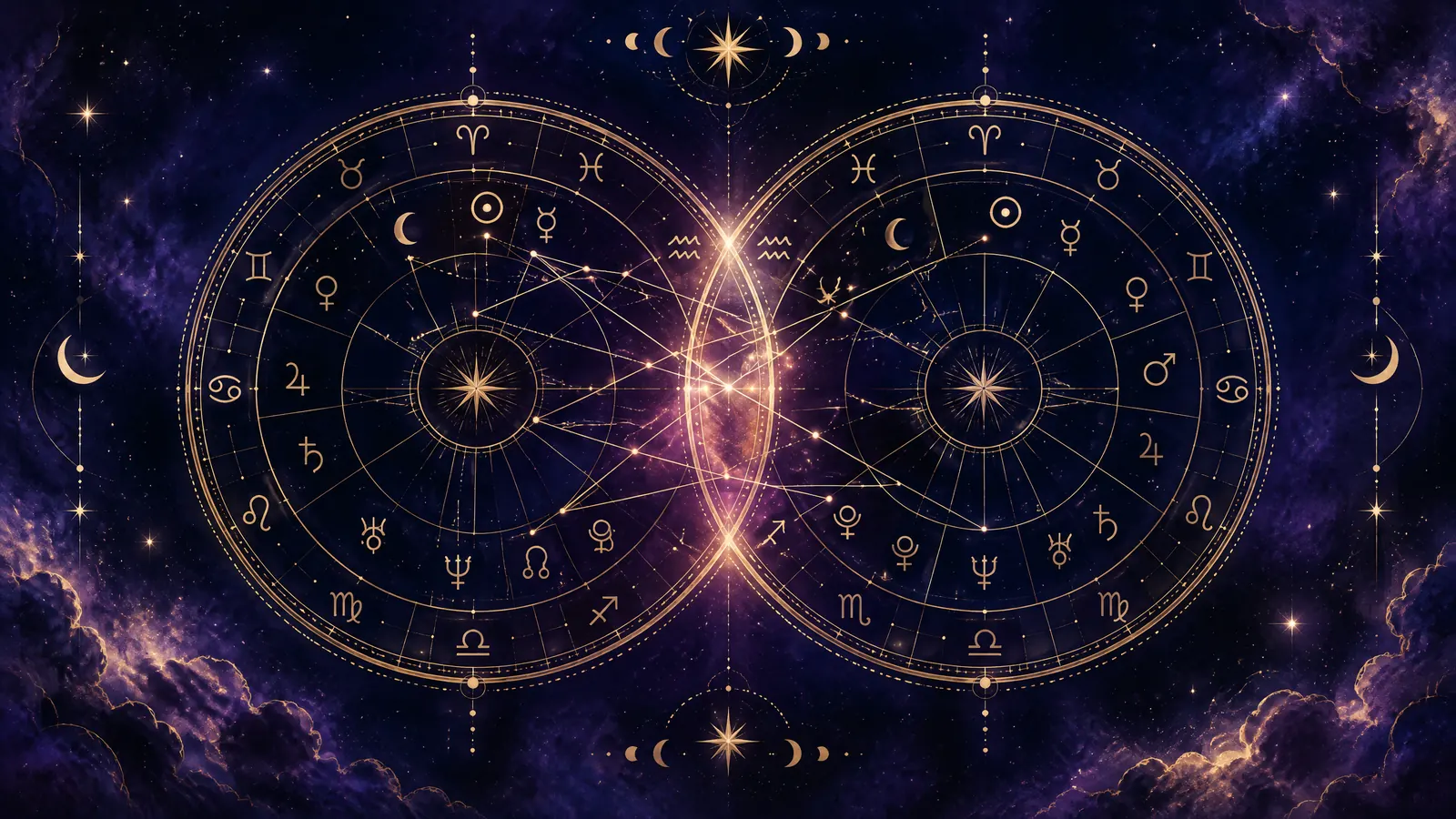
Astrology compatibility is usually studied through synastry: placing two people's birth charts side by side to see how one person's planets touch the other's. Astrologers look first at Sun and Moon contacts, Venus and Mars, Moon to Moon, and Saturn. Compatibility describes dynamics to understand, not a verdict on whether a relationship will last.
What is synastry in astrology?
Synastry is the comparison of two complete birth charts to see how the planets of one person form angles, called aspects, to the planets of the other. It shows where two people naturally understand each other, where they spark, and where they rub.
In practice, an astrologer overlays one chart on the other. If your Venus sits at 14 degrees Taurus and your partner's Moon sits at 12 degrees Virgo, the two are about 120 degrees apart, a trine, which is often read as easy affection and comfort. The same method applies to friends, family members, business partners and parents and children, not only romantic couples. Wikipedia's article on synastry gives a neutral overview of the tradition.
Synastry works best with accurate birth times for both people, because the rising sign and houses show which areas of each person's life the other one activates.
What is a composite chart?
A composite chart is a single chart made from the midpoints between each pair of planets in two birth charts. If one person's Sun is at 0 degrees Aries and the other's is at 0 degrees Gemini, the composite Sun is at 0 degrees Taurus, halfway between.
Where synastry describes how two individuals affect each other, the composite chart describes the relationship itself as a third entity, with its own purpose and challenges. A related method, the Davison chart, uses the midpoint in time and place between two births. Many astrologers read synastry first and use the composite to understand what the partnership is "for."
Which planet contacts do astrologers look at first?
Astrologers usually begin with a handful of contacts that describe identity, feeling, attraction and commitment. Close aspects, within a few degrees, are given the most weight.
- Sun and Moon. One person's Sun touching the other's Moon is one of the classic signs of mutual understanding. The Sun person tends to feel seen, and the Moon person tends to feel cared for. A conjunction, trine or sextile is read as harmonious; a square or opposition as a strong pull that also needs patience.
- Venus and Mars. These describe attraction and desire. Venus shows what each person finds lovely and how they give affection; Mars shows how they pursue, assert and argue. Venus-Mars contacts between charts often describe chemistry.
- Moon and Moon. Comparing Moon signs shows whether two people need the same things to feel safe. Moons in harmonious signs usually mean easier daily living, while clashing Moons can mean one wants closeness when the other wants space.
- Saturn. Saturn contacts to the other person's Sun, Moon or Venus are often read as commitment, loyalty and a sense of duty, and sometimes as heaviness or criticism. Long relationships frequently show Saturn ties, because Saturn describes what lasts.
- The ascendant and the 7th house. Planets that fall on a partner's ascendant or in their 7th house, the house of partnership, are often noticed strongly by both people.
No single contact makes or breaks a relationship. A demanding square can coexist with several supportive trines, and the overall pattern matters more than one aspect. If aspects are new to you, our guide on how to read a birth chart explains the main angles.
Element compatibility: fire, earth, air and water
Elements give a quick first impression of how two people's energies mix. Signs of the same element share a natural rhythm, and fire and air, like earth and water, are traditionally considered complementary.
| Combination | Traditional reading | What to watch |
|---|---|---|
| Fire + Fire | Enthusiasm, shared passion, fast pace | Competition, burnout, quick tempers |
| Fire + Air | Air feeds fire: ideas meet action | Restlessness, avoiding emotional depth |
| Fire + Earth | Vision meets practicality | Impatience versus caution |
| Fire + Water | Passion meets depth | Fire can feel too blunt; water can feel too sensitive |
| Earth + Earth | Stability, loyalty, shared practical goals | Routine, stubbornness |
| Earth + Water | Water nourishes earth: security and care | Withdrawal, worry, holding on too tightly |
| Earth + Air | Plans meet ideas | Air may feel unreliable; earth may feel rigid |
| Air + Air | Conversation, friendship, mental connection | Too much talk, too little feeling |
| Air + Water | Mind meets heart | Logic versus emotion |
| Water + Water | Deep empathy, intuition, emotional bond | Moods amplified, difficulty with boundaries |
In aspect terms, signs of the same element are trine to each other (120 degrees apart), and complementary elements are sextile (60 degrees). Signs of the same modality but different elements, such as Aries and Cancer, are square (90 degrees), which brings friction and growth.
Why is Sun-sign compatibility limited?
Sun-sign compatibility compares only one point in each chart out of dozens. It ignores the Moon, Venus, Mars, Saturn, the rising sign and the houses, which is where most of the relationship information lives.
Consider two people with "incompatible" Sun signs, a Taurus and an Aquarius, which form a square. If the Taurus person's Moon is in Libra and the Aquarius person's Venus is in Libra too, they may share a strong emotional and romantic language that their Sun signs alone would never show. The reverse is also true: two Sun signs that look ideal on paper can sit alongside clashing Moons. You can see how the Sun, Moon and rising sign differ in our article on the big three.
Sun-sign charts are a fine conversation starter. For anything meaningful, compare the full charts.
How should you use compatibility astrology?
Use it as a mirror for understanding, not as a test a relationship passes or fails. Astrology is a symbolic tradition, not a proven science, and no chart can predict whether two people will stay together.
A respectful approach looks like this:
- Look for strengths first. Note the contacts that describe ease, warmth and shared values.
- Name the friction honestly. A Mars square Moon contact, for instance, might suggest one partner's directness can hurt the other's feelings. Knowing that makes kindness easier.
- Remember free will. Many lasting, loving couples have challenging synastry, and they grow because they work with their differences.
- Add other perspectives. Numerology compares life path numbers, which you can explore in our guide to life path number meanings, and Human Design compares how two energy types interact.
Estrella offers a couple compatibility map that reads two people together across Western astrology, Pythagorean numerology, Kabbalah and gematria, Human Design and Gene Keys, with planetary positions calculated from astronomical data for each person's exact birth moment and place. A good place to begin is to create your free soul map for yourself first.
Your own chart is the foundation for understanding any relationship. Start your free first reading on the site in a few questions: name, mother's first name, birth date, birth time if known, and birthplace. The full soul map, a personal PDF of more than 20 pages including a section on love and relationships, is delivered on WhatsApp and is intended for self-reflection, not professional advice.
FAQ
What is the difference between synastry and a composite chart?
Synastry compares two birth charts side by side to see how each person's planets affect the other's. A composite chart blends both charts into one by using the midpoints of each planet pair, describing the relationship as its own entity.
Which signs are most compatible in astrology?
Traditionally, signs of the same element, and fire with air or earth with water, are considered the easiest matches. But this is based on Sun signs only, and the Moon, Venus, Mars and Saturn contacts in two full charts say far more.
Can astrology tell me if my relationship will last?
No. Astrology can describe patterns of ease and tension between two people, but it does not predict outcomes. How two people communicate, choose and grow together matters more than any aspect.
Do I need both birth times for synastry?
Not for the basics. Planet-to-planet contacts can be read from birth dates alone in most cases. Birth times add the rising signs and houses, which show which areas of life each person activates in the other.
Keep reading
How to Read a Birth Chart: A Step-by-Step Guide for Beginners
A plain-English beginner's guide to reading your birth chart: planets, signs, the 12 houses, major aspects and a simple step-by-step order.
Sun, Moon and Rising Meaning: A Clear Guide to Your Big Three in Astrology
Learn what your Sun, Moon and rising signs mean, why the rising sign needs your birth time and place, and how the big three work together.
Life Path Number Meanings: 1 to 9 and Master Numbers 11, 22, 33
Life path number meanings for 1 to 9 and master numbers 11, 22 and 33: archetypes, strengths and challenges. Find your number and get a free reading.
For self-reflection and personal growth only: not a prediction, a promise or professional advice. Maps and texts are created with AI.